
A distinctive basin or WC starts with a design idea, but a purchase-ready product needs more than a rendering. For buyers sourcing custom ceramic sanitary ware, the goal is to turn that idea into an agreed specification covering installation, appearance, performance, packaging and ownership.
A clear brief helps an OEM/ODM supplier assess feasibility and quote the actual scope. It also gives purchasing, design and quality teams one reference when approving samples or reviewing changes. Use the following process before authorizing tooling or production.
1. Define the market, installation and customer use
Start with the destination country and sales channel. A residential bathroom collection, hospitality project and distributor range may have different installation arrangements, documentation needs and service expectations. Identify who will use the product and who will install and maintain it. Record any accessibility requirements that the project team must verify locally.
Describe the installation: countertop, inset or wall-hung basin; floor-mounted or wall-hung WC; concealed or exposed plumbing. Include the proposed supporting furniture, frame, cistern and fittings where relevant. State whether these are supplied with the ceramic product or sourced separately.
For WCs, identify the intended flushing system and outlet arrangement. For basins, identify the tap configuration, waste assembly and overflow requirement. Do not assume that an attractive reference image establishes compatibility with the target market’s plumbing.
2. Convert the concept into controlled drawings
A controlled drawing has a product identifier, revision and approval status. It should distinguish overall dimensions from critical installation dimensions and show the reference points used for measurement. The supplier should propose achievable dimensional limits for review; buyers should not copy arbitrary tolerances from another product.
Use this drawing checklist:
- Overall envelope, installation height and clearance requirements.
- Mounting locations, support surfaces and required fixing interfaces.
- WC rough-in, inlet and outlet interfaces, plus seat and cistern connections where applicable.
- Basin waste connection, overflow configuration, and tap-hole number, position and options.
- Supplied accessories and interfaces with separately purchased fittings.
Attach the relevant fitting drawings rather than relying only on nominal descriptions. A revision that changes a basin’s waste interface must also reach the team buying its waste assembly. Record unresolved points explicitly so that a provisional drawing is not mistaken for a production release.
Cosmetic changes versus functional design changes
A logo placement or colour choice may begin as a cosmetic request. A change to the bowl profile, drainage path, mounting geometry, outlet or tap-hole layout is a functional design change and needs technical assessment.
The distinction is not absolute. A different glaze or finish may affect more than appearance, so the supplier should assess whether it changes surface performance, manufacturability or the approved evidence. Classify each request by its consequences, not by how small it looks on a rendering.
3. Agree the ceramic body, glaze and surface criteria
Ask the supplier to identify the proposed ceramic body and glaze system in the specification. Avoid vague descriptions such as “premium ceramic” when the project needs a defined material reference.
For appearance, provide a physical colour and finish reference where possible. Record whether the target is glossy or matte and identify which surfaces are visible after installation. Digital images can communicate direction, but they should not replace an agreed physical reference for final approval.
Define how appearance will be inspected, including viewing conditions and the areas being evaluated. Agree criteria for colour consistency, glaze coverage, pinholes, visible marks and edge appearance. Establish acceptable limits with the supplier and quality team rather than inventing universal defect sizes or colour tolerances. Photographs of agreed boundary samples can support the written criteria.
4. Approve samples and model-specific performance evidence
Separate appearance approval from installation and performance approval. A sample accepted for colour is not automatically accepted for fit or function. Identify what each sample represents, its drawing revision and which decisions remain open. Confirm whether it is representative of the proposed production process.
For relevant WC designs, BSI’s description of EN 997 covers constructional and performance characteristics and test methods for WC pans and suites with integral traps. It is not a universal standard for every toilet type: the stated exclusions include squatting toilets and pans without integral traps.
For washbasins, BS EN 14688:2015+A1:2018 addresses functional requirements and test methods. Ask the responsible technical or compliance party to confirm the applicable standard, edition, product classification and destination-market obligations before agreeing the test plan.
Request evidence traceable to the proposed model and configuration. Confirm who arranges testing, which samples are used and who reviews the results. A report for a different product should not be accepted without a documented basis for its relevance. Naming a standard in a brief does not establish product compliance.
5. Release a master approved sample and control changes
Once the necessary reviews are complete, identify the master approved sample and link it to the released drawings, finish reference, inspection criteria and accessory list. Agree where reference samples are retained and how purchasing and quality teams access the approval record.
Require written change requests after approval. Each request should identify the affected revision and its implications for fit, appearance, performance evidence and packaging. Establish who can authorize the change, whether new samples or testing are needed, and how existing stock will be handled. An updated rendering alone is not a controlled change record.
6. Design packaging around the transport route
Define the journey from the factory to the buyer and onward to the customer. Include pallet handling, warehouse storage, mixed-load transport and individual parcel delivery where relevant. Discuss protection for exposed edges and separation of accessories, then document the packaging materials, arrangement and labelling.
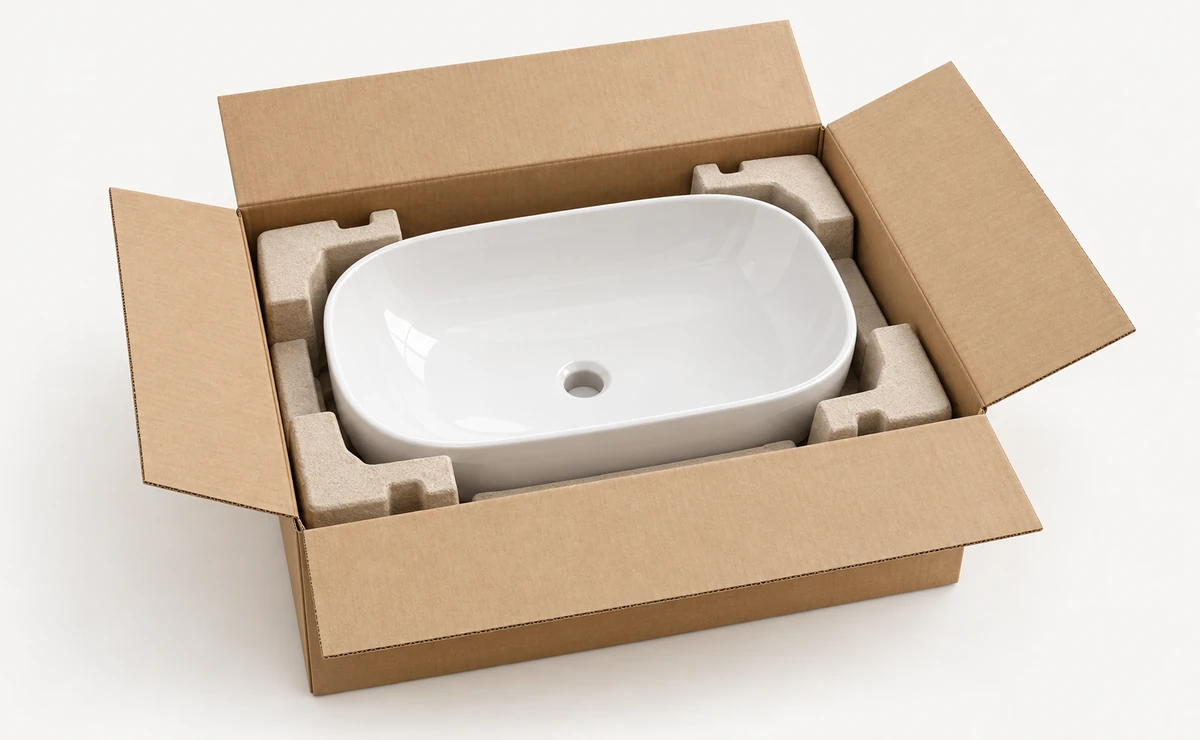
AI-generated editorial illustration of protective packaging for a ceramic basin; not an actual Seri Tanah factory, product or validated packaging design.
ISTA’s design and testing guidance emphasizes understanding the actual distribution environment when selecting a test. It also calls for representative product-and-package samples and damage acceptance criteria established before testing. Agree an appropriate protocol with the packaging specialist or laboratory rather than prescribing an arbitrary drop height. Packaging artwork approval is separate from transport-protection approval.
7. Put responsibilities and ownership in writing
Confirm whether the project modifies an existing design or develops a new one. Assign responsibility for design input, R&D feasibility review, drawings, samples, testing, artwork and final production release.
The commercial documents should address intellectual property, permission to use buyer-supplied designs, confidentiality and any agreed exclusivity. Define mould ownership, permitted use, storage, maintenance and access or transfer arrangements. Do not assume that paying a tooling charge settles ownership rights.
Link the quotation and purchase order to the approved specification. Record sample and tooling charges, order quantities, payment terms, delivery terms and the agreed schedule in the commercial agreement—not as promises inferred from a general product page.
A copyable custom sanitary ware project brief
Send this template with your drawings and reference files. Mark unanswered fields “to be agreed.”
Project / buyer / approval contact:
Product type and model reference:
Destination market and sales channel:
Customer use and accessibility requirements:
Installation type and supporting components:
Drawing file, revision and critical dimensions:
Rough-in / plumbing / mounting interfaces:
Overflow and tap-hole options:
Supplied and separately sourced accessories:
Ceramic body and glaze proposal:
Physical colour / finish reference:
Surface inspection and acceptance criteria:
Applicable standards and evidence required:
Sample purpose, approvals and retained references:
Packaging route, design and validation plan:
Design, testing and release responsibilities:
IP, mould ownership and confidentiality terms:
Requested quantities and delivery requirements:
Open questions and change-approval process:
Discuss your specification with Seri Tanah
Seri Tanah serves international B2B buyers with OEM/ODM options for designs, colours and packaging. Its company-provided profile describes a factory founded in 1993 with a 50,000 m² footprint, focused on mid-to-high-end sanitary ceramics, R&D, mass production and global distribution.
Share your completed brief with Seri Tanah to discuss feasibility and the development scope. Request a proposal tied to your chosen configuration, approval stages and documentation requirements before committing to production.
References
- BSI: BS EN 997—WC pans and WC suites with integral trap
- ANSI catalogue: BS EN 14688:2015+A1:2018—Washbasins, functional requirements and test methods
- ISTA: Getting Started with Design & Testing
Prepared with AI assistance for Seri Tanah. Technical and company-specific claims require review by an authorized company representative before publication.
Learn more about Seri Tanah, or send a sanitary ware project enquiry.