
Choosing a ceramic sanitary ware manufacturer means deciding who can repeatedly deliver products that fit, function and arrive in saleable condition—not simply who offers the lowest quotation. For procurement managers, distributors and project buyers, the strongest shortlist is built on evidence tied to the actual order.
Use five approval gates: supplier identity, product specification, performance evidence, production controls and delivery economics. Do not let an attractive sample compensate for an unresolved failure at another gate.
1. Identify the manufacturer, not just the sales contact
A manufacturer operates production; an exporter or trader may coordinate products made by another business. Either arrangement can work. The risk is undisclosed responsibility, especially when a defect, design change or replacement request crosses company boundaries.
Separate three identities: the legal company signing the contract, the manufacturing site producing the goods, and the product model being purchased. They are not interchangeable. A certificate naming one entity does not automatically cover another factory, while a report for one toilet does not establish the performance of a similar-looking model.
Request the seller’s registration details, factory legal name and address, and a written explanation of their relationship. Establish who controls tooling, approves specifications, releases shipments and handles claims. Ask which operations or components are outsourced and whether production can move to another site without your approval.
Transparency matters more than a “factory-direct” label. An exporter that clearly identifies its manufacturing arrangements can be easier to manage than a claimed manufacturer that refuses traceability.
2. Approve an installation drawing before approving appearance
A catalogue image cannot tell a project buyer whether a basin fits the countertop or a WC connects to the specified drainage arrangement.
Create a controlled drawing for each model and configuration. Cover overall dimensions, mounting points, outlet geometry, tap and waste interfaces, and any relevant seat, cistern or bracket connections. For a basin, identify the cutout or mounting template; for a toilet, identify the installation arrangement and compatible flushing components.
Agree tolerances on that drawing rather than adopting arbitrary numerical limits. Define measurement locations, reference points, methods and acceptance criteria. Where a project specification or applicable standard imposes requirements, incorporate them into the approved documentation.
Record the drawing revision in the purchase order. A “same size” substitution can still create installation problems if an interface changes. Require written approval before changing the ceramic body, tooling or specified components.
3. Separate visual sample checks from functional testing
What a sample can establish
Inspect the sample for glaze appearance, visible defects, colour agreement, finish around openings and conformity to the approved drawing. Define the viewing conditions and which surfaces matter. A distributor displaying products under showroom lighting may have different appearance priorities from a concealed installation.
A sample establishes an agreed reference. It does not prove shipment-wide consistency or every functional requirement.
What needs test evidence
Ask for reports linked to the exact model or a documented product-family scope that legitimately includes it. Check the issuing laboratory, report number, tested configuration, methods and results. Verify important reports with the issuer where possible; a logo or cropped screenshot is insufficient.
The BSI description of EN 997 identifies constructional and performance characteristics and test methods for specified WC types. EN 14688 addresses washbasin functional requirements and test methods. These are examples, not a universal compliance list: confirm the applicable standard and edition for the product and destination.
For a WC, clarify which flushing configuration the evidence covers. A demonstration video may show operation, but it does not replace documented testing under defined conditions. Distinguish tests performed on every unit from periodic production checks and type testing.
4. Turn the approved sample into documented acceptance
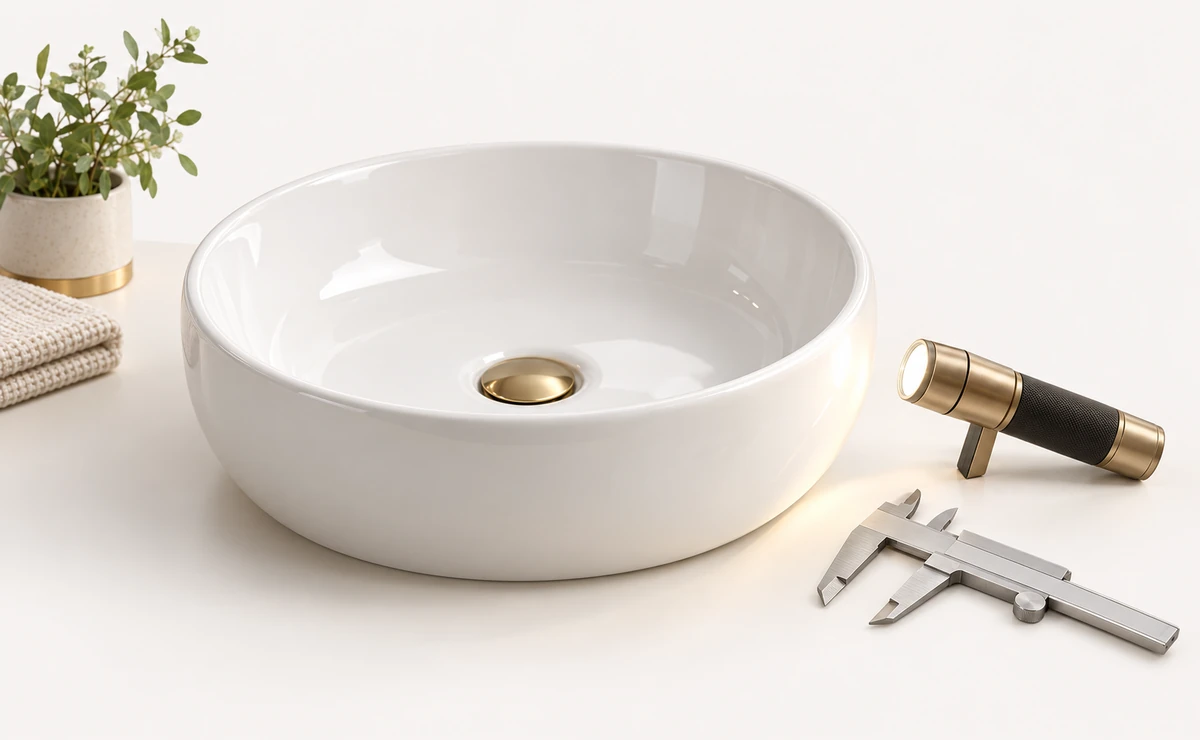
AI-generated editorial illustration of sanitary ware inspection; not a photograph of Seri Tanah’s factory or a verified inspection.
Identify and retain approved samples, with matching references available to buyer, factory and inspector. Link them to model codes, drawing revisions and agreed finish descriptions. If borderline appearance is acceptable, document it rather than relying on someone’s memory.
Before production, agree an acceptance plan covering defect categories, inspection scope, sampling, measurement and functional checks. Specify what happens when goods fail: segregation, corrective action, reinspection and shipment release authority. Do not assume an inspector can invent acceptable limits after production is complete.
Require traceability from inspected goods to production batches and packing records. For repeat orders, ask how the supplier controls changes and confirms that new batches still match the approved specification.
5. Audit capability and verify shipment inspection separately
A factory audit evaluates whether the site can support your order; a shipment inspection evaluates goods against agreed criteria. Neither replaces the other. SGS describes inspection options at different production stages and during loading, including checks against buyer-specific quality plans.
For a factory audit, request a compact evidence pack:
- Site identity and production-flow records showing in-house and outsourced operations.
- Quality-control procedures, measuring-equipment calibration records and relevant test capability.
- Batch traceability, nonconformity records, corrective actions and production-planning evidence.
Use the audit to test whether those records reflect actual practice. A stated capacity figure is not proof of available capacity for your mix of models.
For third-party inspection, agree the provider, site, lot, checklist and reporting route. Obtain the complete report, verify its reference with the provider, and check whether inaccessible stock or unperformed tests limit the conclusion. Record who can authorize release after a failed inspection.
6. Read ISO and CE claims within their actual scope
ISO 9001 concerns a quality management system, not certification of an individual toilet or basin. Check the certificate’s legal entity, covered sites, scope and validity. ISO explains that external bodies issue certificates and provides verification routes; ISO itself does not certify companies.
Avoid treating CE as blanket factory certification. For EU-bound products, establish applicability for the exact product, intended use and regulatory framework. The European Commission’s guidance links construction-product CE marking to applicable harmonised technical specifications or European Technical Assessments and supporting declarations.
Request the applicable declaration, technical evidence and model identification. Confirm the relevant regulatory regime and legally cited specification with a competent destination-market adviser. Do not assume that a report using the newest published standard automatically satisfies marking requirements.
7. Compare delivered cost and shipping risk
Compare quotations on the same configuration, packing specification and named Incoterms rule and place. Include freight, insurance, duties, handling, inspection, storage and realistic exposure to breakage, installation rework and replacement—not just unit price.
Agree packaging for the actual route and handling conditions: protection at vulnerable edges and openings, separation of components, carton identification, and pallet or container arrangements. Request packaging-validation evidence appropriate to the proposed shipment rather than assuming thicker cartons solve every risk.
Define loading checks and retain shipment photographs. Agree how damage is documented, claim responsibilities and replacement arrangements before dispatch. For projects, assess the disruption caused by missing matching pieces; for distributors, assess whether packaging supports warehouse handling and onward delivery.
Questions to copy into your supplier enquiry
- Which legal entity signs our order, and which site manufactures each model?
- Will you approve our drawings, interface tolerances and change-control requirements?
- Which functional reports cover our exact model and supplied configuration?
- How will approved samples and written acceptance criteria control repeat orders?
- Can our auditor and inspector access the site, records and complete shipment?
- What packing evidence, delivery terms and damage-resolution process support your quotation?
Discuss your requirements with Seri Tanah
Seri Tanah describes its role as bridging a factory and international B2B buyers for OEM and ODM sourcing. Its company-provided factory profile states establishment in 1993, a 50,000 m² facility in China’s ceramic capital, and a focus on mid- to high-end sanitary ceramics, R&D, mass production and global distribution. These details require company verification.
Share your target market, model requirements, drawings and packing needs with Seri Tanah to discuss the evidence required for supplier approval.
Prepared with AI assistance for Seri Tanah. Technical and company-specific claims require review by an authorized company representative before publication.
Sources
- BSI: BS EN 997—WC pans and WC suites with integral trap
- BSI: BS EN 14688—Washbasins, functional requirements and test methods
- SGS: Product inspection
- ISO: ISO 9001 explained
- ISO: Certification
- European Commission: CE marking and declaration of performance and conformity
Learn more about Seri Tanah, or send a sanitary ware project enquiry.