
Choosing between OEM and ODM sanitary ware is less about the label on a supplier’s website than about who controls the product and what the quotation includes. For procurement managers, distributors and project buyers, the decision affects design differentiation, approval work and the ability to change suppliers later.
Start with your requirements: can an existing ceramic basin or toilet meet the brief, or does the project need a new design? Then define responsibilities in writing before approving development or placing a production order.
What OEM and ODM mean in sanitary ware sourcing
OEM stands for original equipment manufacturer; ODM stands for original design manufacturer. In new-product sourcing, OEM commonly describes manufacturing based on a buyer’s design, while ODM describes buying a supplier-developed design, potentially with agreed modifications. Sofeast’s manufacturing guide uses this distinction but also discusses borderline arrangements involving existing tooling and minor changes.
For a sanitary ware RFQ, a useful working distinction is:
- OEM: the buyer supplies or commissions the product design, and the supplier develops the agreed manufacturing solution.
- ODM: the supplier offers a design from its range or develops one for the buyer, with customization defined separately.
Treat these labels as commercial shorthand, not standardized contract terms that automatically allocate responsibility or ownership. Adding a logo to a catalogue basin does not establish exclusive design rights. Equally, calling a project OEM does not prove that the buyer owns every drawing or mold.
Ask each supplier to describe the actual arrangement: which design already exists, what will change, who performs the engineering and which deliverables the buyer receives.
Separate design, tooling and commercial rights
Who owns the design and engineering changes?
Identify the buyer’s existing intellectual property, the supplier’s existing designs and the new work created for the project. Agree who owns or licenses each category, including drawings and revisions suggested during development.
Ownership and permission to use a design are different questions. A buyer might license a supplier-owned model without acquiring it outright. Conversely, a buyer-owned concept may still rely on supplier-owned manufacturing know-how. Sofeast cautions that IP rights depend on the agreement rather than the OEM label.
For valuable proprietary designs, have qualified counsel review the ownership, licensing and confidentiality terms under the relevant jurisdiction.
Who controls the molds and technical files?
A tooling payment is not enough to settle ownership or transfer rights. Harris Sliwoski’s tooling guidance separates physical tooling from technical files and the intellectual property embodied in them.
For ceramic sanitary ware, ask the supplier to identify the project-specific tooling covered by its quote. Record who owns it, where it is held and whether subcontractors are involved. Allocate maintenance, replacement and storage costs, then define what happens when the relationship ends.
If supplier transfer matters, specify which editable drawings and technical records must accompany the tooling. Do not assume that moving physical molds alone gives another factory everything needed to reproduce the product.
Is the model exclusive, or only the branding?
Define exclusivity independently of OEM or ODM. Specify whether it covers the model, a design variant, a colour or only branded packaging. State the territory, sales channels and duration, along with any purchasing conditions.
For a distributor, regional exclusivity may matter more than owning a design outright. A project buyer may instead prioritize repeat availability and replacement compatibility. Put the required commercial protection into the agreement rather than relying on the phrase “custom product.”
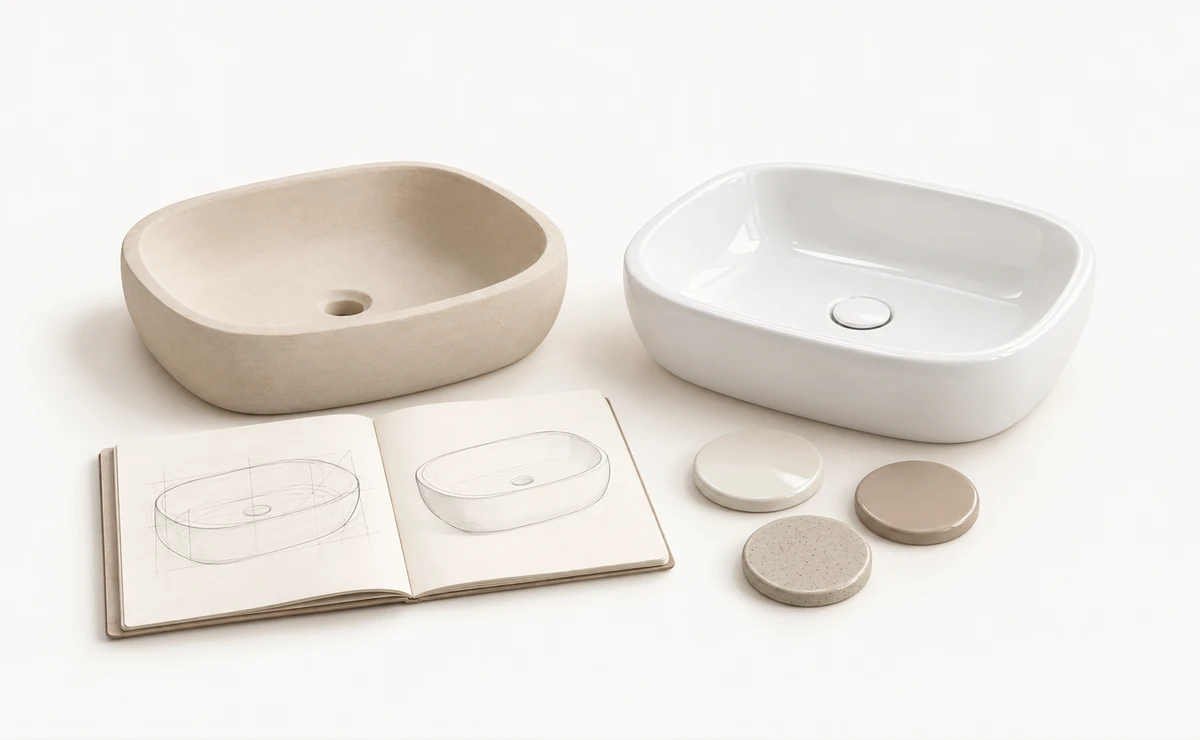
AI-generated editorial illustration of a ceramic basin concept and design materials; not a photograph of a real Seri Tanah factory or product.
Approve a specification, not just an attractive sample
A sample is useful only when both parties know what it proves. Separate appearance approval from dimensional, installation and performance approval. A visually acceptable basin can still fail the project’s fit requirements; a toilet’s appearance does not establish flushing performance.
Build the approval package
Ask for a controlled drawing revision and an agreed specification covering the finished dimensions and tolerances that matter to your installation. For basins, this may include mounting surfaces, tap-hole positions, waste connections and overflow configuration. For toilets, address outlet configuration, installation interfaces and the agreed cistern, seat and flushing components.
Define glaze colour and finish acceptance using approved physical references and agreed viewing conditions. Record how visible defects will be assessed. Identify packaging, labels and included accessories so that approval does not apply only to the ceramic body.
Use a dated, identifiable reference sample linked to the drawing revision. Clarify whether it is a development sample or produced using the intended production tooling and process. Agree which later changes require renewed approval.
Match evidence to the destination market
The applicable requirements depend on the product and sales destination. As one technical reference, ASME A112.19.2-2024/CSA B45.1:24 covers vitreous and non-vitreous china plumbing fixtures and addresses materials, construction, performance, testing and markings. Its scope includes lavatories, urinals and water closets, among other fixtures.
Where a US tank-type toilet programme requires WaterSense, request the relevant product certification. EPA explains that the label requires independent certification against efficiency and performance criteria. That is a product-specific requirement, not a general claim about factory quality.
Ask what evidence applies to the exact model and configuration being ordered. Assign responsibility for arranging testing, paying for it and resolving failures. Sample sign-off should not be treated as a substitute for required compliance evidence.
Compare quotation scope before comparing unit prices
An existing ODM model can reduce new-design and tooling work when it already meets the brief. A buyer-led OEM design may require more development, but it can serve requirements that a catalogue model cannot. Neither label reliably predicts the final cost; compare the work and rights included.
Request separate prices or clear inclusions for development, tooling, samples and production. Identify charges for colour trials, testing, accessories and packaging. Clarify whether development costs are paid separately or recovered through the unit price, and which revisions are included.
Compare the same product configuration, quantities and delivery basis. A ceramic-body-only quote is not equivalent to one including a seat, fittings and retail packaging. Agree the named delivery place and Incoterms rule rather than comparing ambiguous “export prices.”
Ask suppliers to state minimum-order conditions by model and colour, sample stages, production timing and the assumptions behind them. Do not import generic MOQ or lead-time figures into your budget. Also agree how approved samples translate into production inspection and what remedies apply to nonconforming goods.
The practical choice is straightforward: favour ODM when a supplier design meets the specification and its commercial rights are acceptable. Consider OEM when essential dimensions, design identity or product features justify development. For a hybrid arrangement, define each changed element instead of debating the label.
Discuss your sourcing brief with Seri Tanah
According to its company-provided profile, Seri Tanah supports international B2B sanitary ware sourcing and OEM/ODM customization of design, colours and packaging. Share your target market, installation drawings, intended order mix and branding requirements to discuss the appropriate scope. Confirm capabilities, contracting responsibilities and model-specific evidence before purchase.
Buyer checklist before committing
- Choose an existing design, a new design or a clearly defined hybrid.
- Attach the specification, drawing revision and approval criteria to the order.
- Allocate engineering, testing and change-approval responsibilities.
- Document design rights, tooling ownership and handover obligations.
- Define any model exclusivity by territory, channel and duration.
- Compare quotations with matching accessories, packaging and delivery terms.
- Approve the relevant samples and required evidence before releasing production.
Prepared with AI assistance for Seri Tanah. Technical and company-specific claims require review by an authorized company representative before publication.
Sources
- OEM, ODM, Contract Manufacturers: Which Chinese Supplier to Choose? — Sofeast
- Who Owns Your Molds? How to Stop a Factory from Holding Your Tooling Hostage — Harris Sliwoski
- ASME A112.19.2-2024/CSA B45.1:24 — Ceramic plumbing fixtures — CSA Group
- Residential Toilets — US Environmental Protection Agency
Learn more about Seri Tanah, or send a sanitary ware project enquiry.